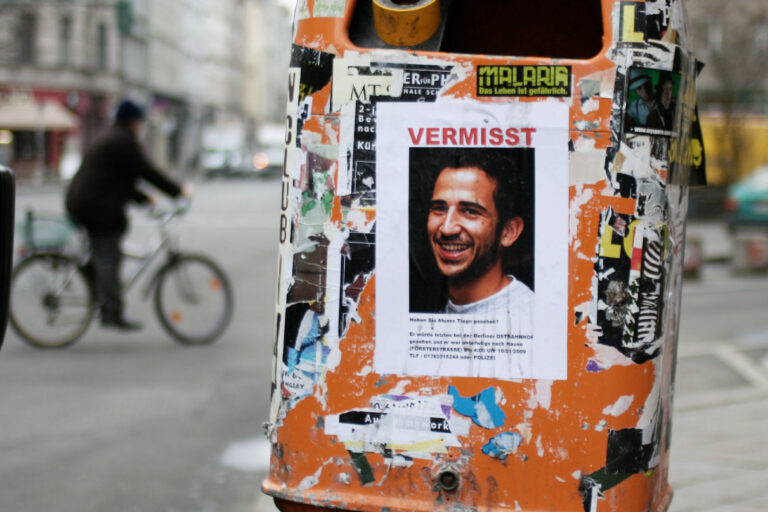
Missing Museum
Humanity and Disappearance
Missing Museum is an art project about the nature of disappearance — the void it creates, the tension it generates, and what remains in the space a person leaves behind.
The project develops out of Missing, Vermisst, Scomparso, initiated in 2009, which examined the psychosocial dimensions of missing persons in contemporary cities: the nature of the disappeared individual, the dynamics of disappearance, and the elements that populate the newly created space of absence. That work is part of the archive of the Agency of Unrealized Projects, curated by Hans Ulrich Obrist and Guy Tortosa. aup.e-flux.com
Missing Museum is currently in a metaproject phase: an archive of drawings, documents and proto-objects — conceptual proposals for the museum’s rooms and installations. The first realized sculpture, The Ladder, is an impossible ladder whose rungs become progressively shorter. The project is not concerned with the search for missing persons but with the void itself — its quality, its weight, what gathers there.
Visitors can leave messages, drawings or reflections in mailboxes placed throughout the exhibition.
References
William Burroughs: the interzone — the liminal territory between presence and absence.
Paul Virilio: picnolepsy — the micro-absences that interrupt consciousness without leaving a trace, as described in The Aesthetics of Disappearance. Disappearance is not only an event that befalls a person; it is a structure of perception itself.
In December 1926, Agatha Christie disappeared. She was found eleven days later, registered at a hotel under another woman’s name. She never explained it.

ink on paper, 28×18 cm

ink on paper, 28×18 cm

ink on paper, 28×18 cm

ink on paper, 28×18 cm

ink on paper, 28×18 cm

ink on paper, 28×18 cm

ink on paper, 28×18 cm

ink on paper, 28×18 cm